viernes, 14 de febrero de 2020

CURATOR FARMERS: WEEK 1

CURATOR FARMERS: WEEK 1

Hey there!! 馃槉馃槉馃槉

First of all to get you into the mood, you can listen this video while reading!


We are the curator famers' team! Our names are Veronica and David and along this week, we have been developing the role known as the curator farmers! 馃懆馃徎‍馃尵馃馃徎‍馃尵

Our main goal has basically been to collect all the information sources we’ve been working with, we have been organising, summarising, and structuring the information to answer the different questions of this second task which was concerned with the ACAD and TPACK frameworks. 馃摑馃搵

Adding to these tasks, we have paid attention in taking care of the written document format and style, trying to make it look as great as we could. 馃憗馃憖 To create the reference list of this task, we have been helped by google scholar and an university file where the main rules are displayed, it is still difficult for us to remember all the rules concerning to the APA style, but we have tried our best!

Moreover, each one of us has also contributed with his/her work and amazing creativity skills to the creation of the poster for the general presentation at the classroom. 馃憣馃徎馃構

We both have found this task a great entertaining and interesting experience, as well as our role being the official information collector or ‘farmers’ of the 8plushalf team! ✅❤️ We have to say as curator farmers, that we have been "harvesting" very positive results and we will "water" and "plant" the suggestions and tips that our teacher gave us in her feedback for the next task!

Hope you all enjoyed this week’s work and keep updated for more!.

See you soon! 馃榿馃槡

References list:
ACAD Framework Animation Mix 2 29/11/18. (2020). Retrieved 6 February 2020, from https://vimeo.com/302378219/ddc8afc306
Cranmer, S. J., Bonderup-Dohn, N., De Laat, M., Ryberg, T., & Sime, J. A. (2016). Proceedings of the Tenth International Conference on Networked Learning 2016: Looking back–moving forward.
Goodyear, P., & Carvalho, L. (2014). Framing the analysis of learning network architectures. In The architecture of productive learning networks (pp. 66-88). Routledge.
Goodyear, P., & Carvalho, L. (2016). Activity centred analysis and design in the evolution of learning networks. In Tenth International Conference on Networked Learning, Lancaster University, Lancaster.
Koehler, M., & Mishra, P. (2009). What is technological pedagogical content knowledge (TPACK)?. Contemporary issues in technology and teacher education, 9(1), 60-70.
The TPACK Framework Explained (With Classroom Examples). (2020). Retrieved 6 February 2020, from https://www.schoology.com/blog/tpack-framework-explained
What Is TPACK Theory and How Can It Be Used in the Classroom? | McGraw-Hill Canada. (2020). Retrieved 6 February 2020, from https://www.mheducation.ca/blog/what-is-tpack-theory-and-how-can-it-be-used-in-the-classroom/

MIND MAP:


STARS: WEEK 1

Hello everybody again!! I am Marina Ruip茅rez with my partner 脕lvaro Ramos in the first week of  work.

Our work of this week was basicaly, doing the presentation with the "speed learning" method since we were the stars馃挮馃憦. After the feedback from our teacher, we recorded the performance to upload it here, to our blog馃拝.

I am Marina and my experience as star was very enriching since I've always found it intimidating to do public exhibitions and more in English. To my surprise, despite being nervous, on the day of the presentation I had a great time with my partner Alvaro馃懌and the groups that listened to us.
The first times I exposed I noticed a little self-conscious but gradually I let go, thus managing to enjoy speaking in public.
I think this work helped me to improve my performances and I'm quite surprised at myself.
Both, the work process and the final exhibition have been two very positive experiences馃憣.
Let's see what the next task will be and my role in it. Looking forward to it!

martes, 11 de febrero de 2020

HERE ARE THE JOURNALISTS: WEEK 1

Hello everybody, this is Megan and Lorena ✌ This week we have had the pleasure to work together as journalists. This is the first time we have ever worked together and we have to say that we make a great team. We are really proud to say that although this is a novelty for our group, as we have never worked in this way, we have really enjoyed it and adapted well to the team work atmosphere.
As journalists we have loved observing and blogging about all our teams work. It has been a full on job that we believe is really important for everyone to understand our development during the week.
We hope you enjoy our blog post as much as we have enjoyed preparing it. :)

In the previous posts we explained what the task of the last week was about and now it has been  succesfully finished we are going to keep you up to date on the processs and the result of our presentation.


Today, 11th of February was our presentation #rict1920 馃捇馃摫

But before, arriving at this point we are going to explain what we have done since last Thursday.
As a very good facilitator馃挮 , Patricia divided the work between us. Our idea for to present TPACK and ACAD to the rest of the class was a brain with different ideas that all together made a puzzle. Each puzzle piece represented a vital question about TPACK and ACAD.
To create the pieces we used a huge variety of materials such as stickers, markers and crayons to make our pieces as visual as posible emphasising on not writing too much text and we believe that the result was satisfactory.  These are some of the pieces: 馃敍


And this was the result:


The 'DAY' arrived and our stars Marina and 脕lvaro 馃専馃専 were prepared and anxious for sharing the knowledge with us馃摉. The distribution of the class was different, we put all the tables and chairs together in the middle of the class and the presentations were disposed on the walls around the classroom. The classroom looked a bit like a museum, the format was 'speed-learning' which means that each group had eight minutes 馃晽 to do their presentations and the rest of the teams moved around the classroom listening to other's teams presentations 馃攬. Here we have our brilliant stars prepared for the presentation:


( Please marry someone that looks at you the way Marina does at 脕lvaro)

Here you have a link to watch how our amazing stars presented our task to the rest of the class.

https://youtu.be/c-piTix02T0


The rest of the group, as we said, were moving around the classroom. Their role was to listen to other peoples presentations and reach an agreement about the best 3 things of each presentation and also point out something that they could improve 馃搵馃搼.

The first group was 'Game of Phones' whose stars were Paula and Mauricio 馃摬. We really enjoyed their presentation. Their speaking skills were wonderful, they looked like professionals. Their presentation was really cool with bright colours that attracted our visual attention and they also made connections between questions. For coming presentations we suggest that they should include less text in the visual presentation.

Moreover, the next group was ' The Cheetah Girls' whose stars were Mar铆a and Laura 馃悊. Their presentation was also pretty good. Some of the best things were the use of emoticons, the fluency of their speech or the distribution of the ideas that was quite novel. Our suggestion is that they make the main ideas bigger because it was a bit difficult to see and that they talk louder because with the general noise of the classroom was quite loud, we had difficulties hearing them.

The following group was 'The Outsiders' whose stars were Paco and Miguel 馃憪. Their work was less visual and colourful than the previous ones and the duration of the speech was a little bit reduced. But also, they had some good things. They interacted with us, something that in our opini贸n was lacking  in previous presentations. They also connected knowledge from this task with previous subjects and knowledge we have acquired in our degree.Finally we would like to highlight that had  great fluency, it was clear that they understood what they were saying.

Afterwards, came 'TICchers'  馃摮馃捇 whose stars were Mar铆a and Lola. In this presentation we were witnesses of a great teamwork between the stars. Moreover, the presentation was visually attractive and the way of presenting the ideas was original. Their failure was, like in other groups, the saturation of text in the presentation.

Lastly. 'The Picklers' whose stars were Natalia and Marta showed us their presentation 馃崘馃崈
This presentation was great. It was very visual and they used a huge variety of metaphors and examples to make the presentation more 'wordly' we think they explained everything really well. Also, they explained the reasons why they had chosen the way to present their presentation. If we have to point out something that we think could be improved, we would say the English pronunciation sometimes was not so good.

Having finished our presentations we listened to some feedback from our teachers of things that we can improve in following presentations. We found it helpful as for some this was our first "speed learning". 

However, our responsability as journalists does not end here.

As historians we have been doing some research on different blogs we think are handy for this subject and for teaching as future teachers. The first blog we are going to mention, talks about technology in the classroom. If it is a possitive resource for these “digital natives” we have as students. Also, we find helpful that it gives you some ideas of tools we can use in the classroom.

Although, the blog is aimed for teaching English to foreign students, we are on a bilingual course so we thought it could be helpful to be advised, not only as future teachers but also as current students.  In addition, we consider that nowadays, bearing in mind that most schools are bilingual, it is very useful to be kept up to date about how to  adapt English to any subject you want to teach.

https://www.teachingenglish.org.uk/blogs/raquel-ribeiro/smartphones-learning-possibilities-efl-class


Secondly we have been observing our classmates work and we really took an interest to the blog created by the group "Game of phones". We think their posts are well explained and visually it is striking to catch peoples attention.

https://planningforteaching705429415.wordpress.com/2020/02/13/game-of-phones-2/


We hope that you have enjoyed reading this post and see you soon 馃挄馃槝
PD: This is a photo of our wonderful group of future teachers 馃懄馃懅


jueves, 6 de febrero de 2020

JOURNALISTS: WEEK 1

Hello everybody, we are Meggan Higgins and Lorena Espa帽a and this week we are the journalist 馃槉.
Today we are going to talk about the new task we are doing in #RICT1920 馃捇馃摬


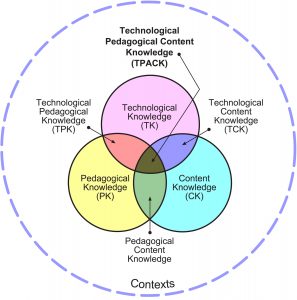
We are studying the TPACK and ACAD frameworks. On the one side, TPACK framework stands for Technological Pedagogical Content Knowledge. It is a theory that was developed to explain the set of knowledge that teachers need to teach their students a subject, teach effectively, and use technology. TPACK gives us three knowledge areas to consider: Technology, Pedagogy, and Content Knowledge. Arranging these three categories into a Venn diagram helps us to see the four areas that are created in Mishra and Koehler’s framework.


TPACK model diagram


Content Knowledge (CK) describes teachers’ own knowledge of the subject matter, Pedagogical Knowledge (PK)  describes teachers’ knowledge of the practices, processes, and methods regarding teaching and learning and Technological Knowledge (TK) describes teachers’ knowledge of, and ability to use, various technologies, technological tools, and associated resources and they all interact with each other.

On the other side, the activity-centred analysis and design (ACAD) framework it's focused on doing tasks, that are determined by the physical setting that can be a building or a room and it aslo includes artifacts like funiture, hardware or books , by the social situation that are the relationships established for carrying out the task and lastly by epistemetic task design that is the task itself


Resultado de imagen de acad framework


To explain these concepts to our classmates we have to design an information map that explains the characterictics of each framework and the interactions and connections with each other. In class we started to work by collecting information about these framework and share it with each member of the group so everbody understand what they mean. 馃椇


This is our group of students very focused on their work ( except Lorena, who was taking the picture, but also working) 馃槃


In the future 'last week 1 post ', we will show you some photos about our presentation by our stars Marina and 脕lvaro and we will explain our information map 

We hope that you have enjoyed reading this post and see you in the next one !!! 馃挆馃挋馃挌馃挍馃挏


WEEK 1 ROLES

Hello everybody, in this post we are going to talk about ecah one of the roles in our subject, this week #RICT1920 馃捇馃摬

Stars 馃専馃専: Marina Ruiper茅z and 脕lvaro Ramos
Journalists- historians 馃搼馃搳: Megan Higgins and Lorena Espa帽a
Facilitator- administrator 馃挮: Patricia Caja
Curator-farmer 馃搵: Ver贸nica Cano and David Romero
Translator 馃埜: Luc铆a Alarc贸n
Analyst 馃摎: F谩tima El Mnari

We hope you have enjoyed reading our posts and see you in the next one !!! 馃挊

INTRODUCTION

Hello everybody, we are Eight Plus Half, a group from Murcia's university.馃彨
We are studying the degree of Primary Education and we have created this blog for the subject Resources and ICT. #rict1920馃憟馃憟
In this blog we will talk about the importance of the use of technologies to improve our learning and teaching techniques. 馃摬馃捇
Our group of future Primary teachers is made up by Megan Higgins, Ver贸nica Cano, Lorena Espa帽a, Patricia Caja, David Romero, Marina Ruip茅rez, Luc铆a Alarc贸n, 脕lvaro Ramos and F谩tima El Mnari 馃檶馃懄馃懅
I hope you enjoy reading our posts and see you soon!!! 馃挀馃挐